Cost Optimization
28 articles tagged with "Cost Optimization"
30 Snowflake Interview Questions for Data Engineers
Core Snowflake interview topics: architecture, warehouses, recovery, loading, and security — emphasize trade-offs in cost, speed, and risk.
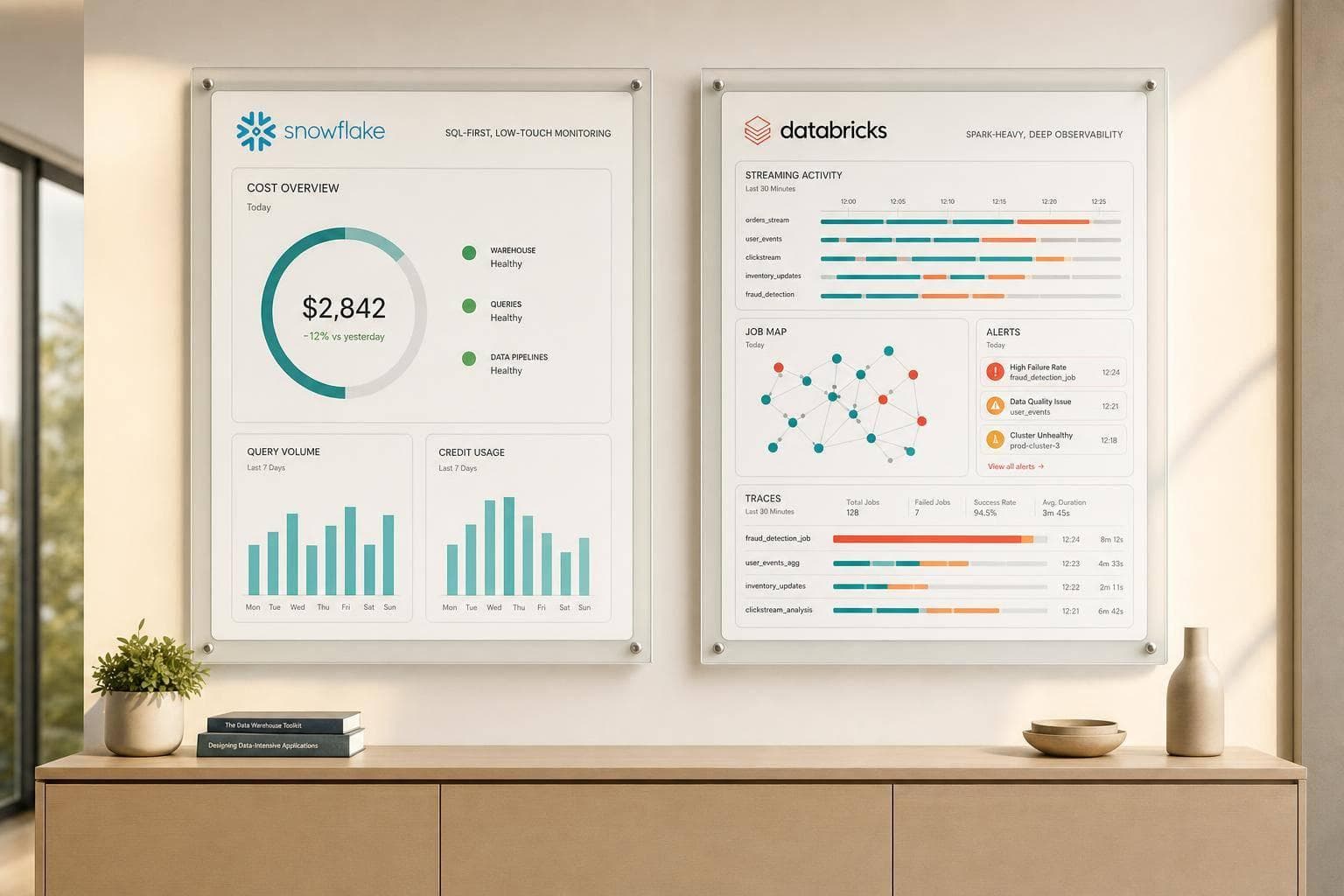
Snowflake vs. Databricks: Monitoring Features Compared
SQL-first platforms favor low-touch monitoring and credit controls, while Spark-heavy stacks demand deeper job and streaming observability.

Case Study: Caching with Databricks for Faster Analytics
Cut scans from 2.3TB to 8GB and reduce compute costs 73% using Disk Cache, Spark cache, SQL result cache and improved file layout.

Top Tools for Data Lakehouse and Data Warehouse
Choose a lakehouse for unified SQL, ML, and streaming - use open formats and governance to avoid lock-in and control costs.

Snowflake for Data Retention: Best Practices
Set Time Travel, Fail-safe, storage tiers and lifecycle policies to balance compliance, recovery, and storage cost in Snowflake.

ETL Pipeline Benchmarking: Metrics to Track
Measuring the right ETL metrics—throughput, freshness, quality, cost, and scalability—prevents silent failures and runaway cloud spend.
Snowflake Query Tuning: Best Practices for Low Latency
Practical Snowflake tuning: right-size warehouses, improve micro-partitioning, optimize SQL and caching to cut query latency.

How to Optimize Data Flow in Distributed ML Pipelines
Profile pipelines, optimize storage and formats, parallelize loading and shuffling, and cache to boost GPU utilization and cut costs.

How to Troubleshoot Cloud Data Warehouse Issues
Diagnose root causes—connections, slow queries, storage, and security—and apply targeted fixes to cut costs and boost cloud data warehouse performance.

Databricks ETL Optimization for Petabyte Data
Guide to tuning Databricks for petabyte ETL: cluster sizing, Delta Lake layout, Auto Loader, AQE, and predictive optimization.

Case Study: Improving Dashboard Speed with Snowflake
Diagnose and fix Snowflake dashboard slowness with caching, warehouse tuning, clustering, materialized views and search optimization.

Snowflake Bottlenecks: Troubleshooting Tips
Query design, not warehouse size, is often the real reason Snowflake slows; profile queries, reduce I/O, optimize loads, and right-size resources.